
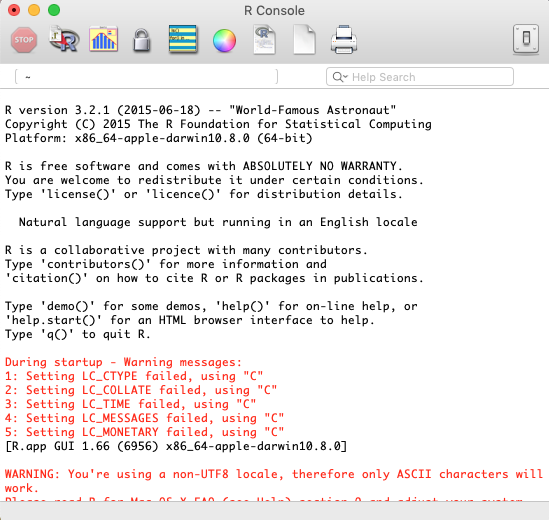
The complete install packages for Mac OS X are named Moodle4Mac and allow a very easy way to install Moodle on your Mac computer (laptop, desktop or test server). Moodle4Mac is available from Moodle packages for Mac OS X. Moodle4Mac is based on the software MAMP. On Mac OS X packages can be installed in three ways: Using Package Manager in the R.APP GUI (recommended for most Mac users) Using install.packages command in R; Using R CMD INSTALL command in the shell (aka Terminal) The latter two methods are common to all Unix systems and as such described in the general R documentation. The Missing Package Manager for macOS (or Linux). It's all Git and Ruby underneath, so hack away with the knowledge that you can easily revert your modifications and merge upstream updates. Using my MBP 16', I used the Download OS X El Capitan link on Apple's support site to get the installer. Unfortunately, running the InstallMacOSX.pkg package in the DMG failed: This version of OS X 10.11 cannot be installed on this computer. I 'found' a Install OS X El Capitan.app package and was able to create the bootable media.

Bob Savage <bobsavage@mac.com>
Start quickly with the most recent versions of Word, Excel, PowerPoint, Outlook, OneNote and OneDrive —combining the familiarity of Office and the unique Mac features you love. Work online or offline, on your own or with others in real time—whatever works for what you’re doing.
Python on a Macintosh running Mac OS X is in principle very similar to Python onany other Unix platform, but there are a number of additional features such asthe IDE and the Package Manager that are worth pointing out.
4.1. Getting and Installing MacPython
Mac OS X 10.8 comes with Python 2.7 pre-installed by Apple. If you wish, youare invited to install the most recent version of Python 3 from the Pythonwebsite (https://www.python.org). A current “universal binary” build of Python,which runs natively on the Mac’s new Intel and legacy PPC CPU’s, is availablethere.
What you get after installing is a number of things:
A
Python3.9folder in yourApplicationsfolder. In hereyou find IDLE, the development environment that is a standard part of officialPython distributions; and PythonLauncher, which handles double-clicking Pythonscripts from the Finder.A framework
/Library/Frameworks/Python.framework, which includes thePython executable and libraries. The installer adds this location to your shellpath. To uninstall MacPython, you can simply remove these three things. Asymlink to the Python executable is placed in /usr/local/bin/.
The Apple-provided build of Python is installed in/System/Library/Frameworks/Python.framework and /usr/bin/python,respectively. You should never modify or delete these, as they areApple-controlled and are used by Apple- or third-party software. Remember thatif you choose to install a newer Python version from python.org, you will havetwo different but functional Python installations on your computer, so it willbe important that your paths and usages are consistent with what you want to do.
IDLE includes a help menu that allows you to access Python documentation. If youare completely new to Python you should start reading the tutorial introductionin that document.
If you are familiar with Python on other Unix platforms you should read thesection on running Python scripts from the Unix shell.
4.1.1. How to run a Python script
Your best way to get started with Python on Mac OS X is through the IDLEintegrated development environment, see section The IDE and use the Help menuwhen the IDE is running.
If you want to run Python scripts from the Terminal window command line or fromthe Finder you first need an editor to create your script. Mac OS X comes with anumber of standard Unix command line editors, vim andemacs among them. If you want a more Mac-like editor,BBEdit or TextWrangler from Bare Bones Software (seehttp://www.barebones.com/products/bbedit/index.html) are good choices, as isTextMate (see https://macromates.com/). Other editors includeGvim (http://macvim-dev.github.io/macvim/) and Aquamacs(http://aquamacs.org/).
To run your script from the Terminal window you must make sure that/usr/local/bin is in your shell search path.
To run your script from the Finder you have two options:
Drag it to PythonLauncher
Select PythonLauncher as the default application to open yourscript (or any .py script) through the finder Info window and double-click it.PythonLauncher has various preferences to control how your script islaunched. Option-dragging allows you to change these for one invocation, or useits Preferences menu to change things globally.
4.1.2. Running scripts with a GUI
With older versions of Python, there is one Mac OS X quirk that you need to beaware of: programs that talk to the Aqua window manager (in other words,anything that has a GUI) need to be run in a special way. Use pythonwinstead of python to start such scripts.
With Python 3.9, you can use either python or pythonw.
4.1.3. Configuration
Python on OS X honors all standard Unix environment variables such asPYTHONPATH, but setting these variables for programs started from theFinder is non-standard as the Finder does not read your .profile or.cshrc at startup. You need to create a file~/.MacOSX/environment.plist. See Apple’s Technical Document QA1067 fordetails.
For more information on installation Python packages in MacPython, see sectionInstalling Additional Python Packages.
4.2. The IDE
MacPython ships with the standard IDLE development environment. A goodintroduction to using IDLE can be found athttp://www.hashcollision.org/hkn/python/idle_intro/index.html.
4.3. Installing Additional Python Packages
There are several methods to install additional Python packages:
Packages can be installed via the standard Python distutils mode (
pythonsetup.pyinstall).Many packages can also be installed via the setuptools extensionor pip wrapper, see https://pip.pypa.io/.
4.4. GUI Programming on the Mac
There are several options for building GUI applications on the Mac with Python.
PyObjC is a Python binding to Apple’s Objective-C/Cocoa framework, which isthe foundation of most modern Mac development. Information on PyObjC isavailable from https://pypi.org/project/pyobjc/.

The standard Python GUI toolkit is tkinter, based on the cross-platformTk toolkit (https://www.tcl.tk). An Aqua-native version of Tk is bundled with OSX by Apple, and the latest version can be downloaded and installed fromhttps://www.activestate.com; it can also be built from source.
wxPython is another popular cross-platform GUI toolkit that runs natively onMac OS X. Packages and documentation are available from https://www.wxpython.org.
PyQt is another popular cross-platform GUI toolkit that runs natively on MacOS X. More information can be found athttps://riverbankcomputing.com/software/pyqt/intro.
4.5. Distributing Python Applications on the Mac
The standard tool for deploying standalone Python applications on the Mac ispy2app. More information on installing and using py2app can be foundat http://undefined.org/python/#py2app.
4.6. Other Resources
The MacPython mailing list is an excellent support resource for Python users anddevelopers on the Mac:
Another useful resource is the MacPython wiki:
The following article uses options that are available starting with the Professional edition and project type.
This tutorial will guide you through the packaging of a Java application into a Mac OS X compliant package.
- 1. Create project
- 2. Add Installation Files
- 3. Add the Mac OS X build
- 4. Define Java Product
- 5. Build
- 6. Video tutorial
1. Create project
Start Advanced Installer. Launching Advanced Installer automatically starts a new installation project. Choose “Java” > “Java Application” as the project type.
A good idea is to save and name the project at this point. Use the “Save” menu item under the “File” menu or the Ctrl+S keyboard shortcut and let's name it MacOSXPackage.aip.
2. Add Installation Files
Go to the Files and Folders page by clicking on “Files and Folders” on the left pane.
Right click “Application Folder” and select “Add Files”. Browse to the source folder on disk of your JAR file and select it. Click OK.
3. Add the Mac OS X build
Mac Os Package Manager
Go to the Builds page by clicking on “Builds” on the left pane.
Create a new Mac OS X build by clicking on the toolbar button.
For Mac Os X
4. Define Java Product
Go to the Java Products page by clicking on “Java Products” on the left side page menu.
Create a new Java Product by clicking on the toolbar button.
Click on the button and browse to and select the JAR file you added in “Files and Folders” page. Click OK.
Go to “Mac OS X” tab and check the “Include the Java Product in the Mac OS build” option.
5. Build
Os X Package Maker
Click on the toolbar button. Two setup packages will be built: a Windows compliant setup and a Mac OS X compliant package. The built Mac OS X package is a self extracting ZIP archive.
Mac Os Package Installer
6. Video tutorial