
- Due to an incompatibility in PCIe addressing schemes, the SOLO, DUO, and QUAD versions of this card are incompatible when hosted by the new Mac Pro (2013). Aside from the new Mac Pro, they are compatible with the rest of the currently shipping Macs and most PCs.
- The Thunderbolt 3 Pro Dock from OWC is built for ultimate bandwidth and speed, and is aimed at creative professionals who require the fastest speeds possible. Wired Internet, memory card.
Information about these and other types of Mac ports is in the specifications for your Mac: Choose Apple menu > About This Mac, click Support, then click Specifications. Or check your Mac user guide.
WIWU USB-C Hub with Type C, Aluminum USB 3.0 Ports and SD/TF Card Reader for Apple MacBook 12/New MacBook Pro -2016 with Thunderbolt 2 Port/ChromeBook and More, Multi-Port Adapter - Gray. Model #: B07DCPNKBS; Return Policy: View Return Policy $. The Thunderbolt 3 (USB-C) ports on MacBook Pro, MacBook Air, iMac Pro, iMac, and Mac mini are fully compatible with your existing devices and displays. Use the chart below to find out which adapter or cable you’ll need to connect to the ports on all your favorite devices.
Thunderbolt 3
Use Thunderbolt 3 with displays and other devices that connect using either a Thunderbolt 3 cable or USB-C cable. You can also connect a USB-C power adapter and cable to charge your notebook computer. If you have a device that doesn't connect to this port, you might be able to use an adapter to connect it.
These Mac models have Thunderbolt 3 ports:
- MacBook Pro introduced in 2016 or later
- MacBook Air introduced in 2018 or later
- iMac introduced in 2017 or later
- iMac Pro (all models)
- Mac mini introduced in 2018
- Mac Pro introduced in 2019
If your Mac notebook or desktop computer has more than one port like this, each port supports ThunderBolt 3 and USB-C.
USB-C
Use USB-C with displays and other devices that connect using a USB-C cable. You can also connect a USB-C power adapter and cable to charge your notebook computer. If you have a device that doesn't connect to this port, you might be able to use an adapter to connect it.
MacBook models introduced in 2015 or later have a single USB-C port. This port doesn't support Thunderbolt devices.
If your Mac has only one port like this, it's a MacBook that supports USB-C but not Thunderbolt.
Thunderbolt
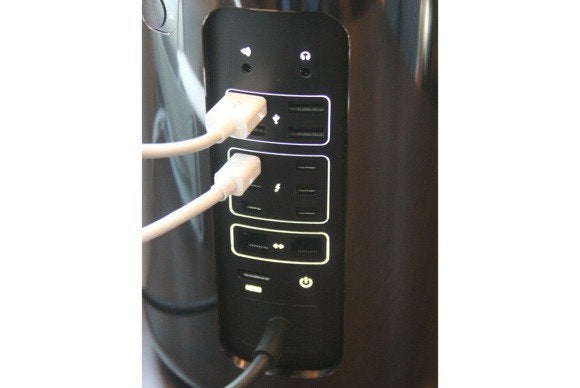
Use Thunderbolt or Thunderbolt 2 with displays and other devices that connect using a Thunderbolt cable.
These Mac models have Thunderbolt or Thunderbolt 2 ports:
- MacBook Pro introduced in 2011 through 2015
- MacBook Air introduced in 2011 through 2017
- Mac mini introduced in 2011 through 2014
- iMac introduced in 2011 through 2015
- Mac Pro introduced in 2013
Thunderbolt and Thunderbolt 2 are not the same as Mini DisplayPort . They have the same shape, but use different symbols on the cable and port. However, this port does support Mini DisplayPort for video output, so you can use a Mini DisplayPort cable to connect a Mini DisplayPort display.
Mini DisplayPort
Use Mini DisplayPort with displays that connect using a Mini DisplayPort cable.
These Mac models have Mini DisplayPort:
- MacBook Pro introduced in late 2008 through 2010
- MacBook Air introduced in late 2008 through 2010
- Mac mini introduced in 2009 and 2010
- iMac introduced in 2009 and 2010
- Mac Pro introduced in 2009 through 2012
Mini DisplayPort is not the same as Thunderbolt or Thunderbolt 2 . They have the same shape, but use different symbols on the cable and port.
USB-A
Use USB-A with devices that connect using a USB cable. USB ports are sometimes known by the USB specification of the port, such as USB 2 or USB 3.
Left to right: power, two Thunderbolt, USB-A, and Audio-Out.
HDMI
Use HDMI with displays and TVs that connect using an HDMI cable.
Ethernet
Use Ethernet with networks and devices that connect using an Ethernet (RJ45) cable.
FireWire
Use FireWire with devices that connect using a FireWire 400 or FireWire 800 cable.
SD card
Use the SD card slot with SD, SDHC, SDXC, MMC, and UHS-II media cards, such as those used by digital cameras.
Audio
Use Audio-Out — or — with headphones, speakers, and other audio-output devices that connect using an audio cable that has a 3.5 mm (1/8 inch) audio jack.
Card Thunderbolt For Mac Pro 15
Use Audio-In with a microphone or other audio-input device that connects using an audio cable that has a 3.5 mm (1/8 inch) audio jack.
Power
Use the power port , if available, to connect your computer to AC power using a MagSafe cable or adapter. This port isn't available on newer Mac notebook computers, which use Thunderbolt 3 or USB-C for power and charging. Learn more about power adapters and cables for Mac notebook computers.
Learn more
The Mac Pro introduced in 2019 has eight PCIe slots:
- Four double-wide slots
- Three single-wide slots
- One half-length slot preconfigured with the Apple I/O card
Mac Pro includes one or two Radeon Pro MPX Modules that occupy slots 1-2 and slots 3-4. You can choose your MPX Modules when you order your Mac Pro or order them separately from Apple. Learn how to install PCI cards in your Mac Pro (2019).
Apple AMD Radeon MPX Modules

Apple currently has four different Mac Pro Expansion (MPX) Modules that contain AMD Radeon Pro graphics processing units (GPUs). Radeon Pro MPX Modules can use slots 1-2 and slots 3-4, and you can install one or two of each module:
- Radeon Pro 580X MPX Module: one module only
- Radeon Pro W5700X MPX Module: one or two modules
- Radeon Pro W5500X MPX Module: one or two modules
- Radeon Pro Vega II MPX Module: one or two modules
- Radeon Pro Vega II Duo MPX Module: one or two modules
You can use Radeon MPX Modules along with other third-party PCIe graphics cards. If you use Boot Camp, using a Radeon MPX Module and a third-party AMD graphics card isn't supported when your Mac is using Windows. Learn about using AMD graphics cards with Microsoft Windows on Mac Pro (2019).
Apple I/O card
Mac Pro comes with the Apple I/O card, which has two Thunderbolt 3 ports, two USB-A ports, and a 3.5mm headphone jack. The Apple I/O card comes preinstalled in slot 8 and can't be installed in another slot.
Third-party PCIe cards
You can install many different PCIe cards in your Mac Pro, such as fibre channel cards, fibre networking cards, and pro video and audio interface cards. The PCIe bus on your Mac Pro provides up to 300W auxillary power. If your PCIe card requires additional power, such as a GPU, use the Belkin Aux Power Cable.
Mac Pro supports the same GPUs that are supported by external graphics processors (eGPUs). If you use Boot Camp and want to install a NVIDIA card to use in Windows on your Mac, don't install the card in slot 2. Learn about using AMD graphics cards with Microsoft Windows on Mac Pro (2019).
Some older PCI cards might use 32-bit Option ROMs that aren't compatible with your Mac Pro. If you install a PCI card that uses 32-bit option ROMs, your Mac Pro might not start up correctly.
Afterburner
Thunderbolt 3 Card For Mac Pro
Afterburner is a hardware accelerator card made by Apple. Learn more about Afterburner.
RAID cards
If you want to add additional storage, you can install a third-party RAID card, such as a SAS RAID card, or you can install the Promise Pegasus R4i 32TB RAID MPX Module in one of the two MPX bays. If you use Boot Camp on your Mac, Windows doesn't support Apple software RAID volumes.
Thunderbolt Sd Card Reader
Learn more